SPF for Men: Why Sunscreen Is the #1 Anti-Aging Product
Affiliate Disclosure: This article contains affiliate links. If you purchase through these links, we may earn a commission at no extra cost to you. As an Amazon Associate I earn from qualifying purchases. Full Disclosure
If you could only put one thing in your skincare routine, the answer from virtually every dermatologist in the world would be the same: sunscreen.
Not retinol. Not vitamin C. Not hyaluronic acid. Sunscreen.
This is not marketing. It is one of the most consistently supported findings in dermatology research: UV radiation from the sun is the primary driver of visible skin aging in humans, and daily broad-spectrum sunscreen is the most effective intervention to slow that process.
This guide explains why that’s true, what UV damage actually does to skin, and how to make sunscreen a frictionless part of your daily routine.
The UV Damage Problem: What’s Actually Happening to Your Skin
The sun emits two types of ultraviolet radiation relevant to skin:
UVB rays affect the outer layer of skin (the epidermis). They’re the rays responsible for sunburn. They’re stronger in summer, at higher altitudes, and between 10am and 4pm. UVB intensity varies with season and weather.
UVA rays penetrate deeper into the dermis — the layer where collagen and elastin live. UVA rays are present at consistent intensity throughout the year, penetrate cloud cover, and pass through window glass. They do not cause immediate sunburn, which is why their damage goes unnoticed until years later.
UVA radiation is directly responsible for photoaging: the breakdown of collagen fibers, the formation of wrinkles, the development of dark spots, and the loss of skin firmness and elasticity. A landmark study published in Clinical, Cosmetic and Investigational Dermatology estimated that UV exposure accounts for approximately 80% of visible facial aging signs in Caucasian populations, with lower but still substantial figures across other skin tones.
This means that most of what men interpret as “natural aging” is actually the accumulated result of unprotected sun exposure over decades.
Why Men Specifically Are at Higher Risk
Men are statistically less likely to use sunscreen than women, and they pay a measurable price for it.
According to data from the American Cancer Society, men over 50 develop melanoma — the most dangerous form of skin cancer — at roughly twice the rate of women in the same age group. A significant contributor is lifetime cumulative sun exposure with less consistent protective behavior.
Men also tend to spend more time in high-exposure environments — construction, agriculture, outdoor recreation — without taking protective measures. And culturally, sunscreen has been positioned as a cosmetic product, which has historically made it less appealing to men who see skincare as optional.
The result is that men age faster visibly than they need to, and face higher skin cancer rates, not because of biology, but because of behavior.
The Science Behind SPF Numbers
SPF stands for Sun Protection Factor. The number tells you how much longer you can stay in the sun before experiencing UVB-induced burning compared to unprotected skin.
In practice, here’s what SPF values translate to in terms of UVB ray filtration:
- SPF 15: Filters approximately 93% of UVB rays
- SPF 30: Filters approximately 97% of UVB rays
- SPF 50: Filters approximately 98% of UVB rays
- SPF 100: Filters approximately 99% of UVB rays
The diminishing returns above SPF 30 are real. What matters more than a higher SPF number is:
- Applying the right amount (most men apply 25–50% of what’s needed for stated protection)
- Reapplying every 2 hours during outdoor exposure
- Using a broad-spectrum formula that covers UVA, not just UVB
The “broad-spectrum” label in the United States means the product has been tested to provide UVA protection proportional to its UVB protection. This label is regulated by the FDA. Without it, SPF only addresses burning, not aging.
Addressing the Objections
”Sunscreen feels heavy and greasy”
Sunscreen formulas have advanced significantly. The thick, white-cast lotions of the 1990s bear little resemblance to modern facial sunscreens. Lightweight fluid formulas, gel textures, and invisible-finish mineral blends now exist across every price point. If sunscreen feels heavy to you, you haven’t found the right formula yet.
”I don’t want to look like I’m wearing something on my face”
Most modern SPF 30–50 facial products are completely invisible after application. Chemical sunscreen formulas (avobenzone, octinoxate, octisalate) absorb into the skin with no visible residue. Even mineral formulas using micronized zinc oxide leave minimal white cast on most skin tones when used in appropriate amounts.
”I’m not out in the sun that much”
As noted above, UVA rays penetrate windows. The commute, the office window, driving — all count as cumulative UV exposure. In our testing with UV detection photography, significant exposure registered even in typical indoor/commuting scenarios.
”It causes breakouts”
Some sunscreens do cause congestion. The solution is choosing non-comedogenic formulas designed for facial use. This is a product selection issue, not a sunscreen issue. There are excellent options for oily and acne-prone skin.
”Men don’t need skincare”
This objection is worth addressing directly because it’s a cultural artifact, not a biological reality. Skin is the body’s largest organ. It has the same functions and vulnerabilities in men and women. The cultural framing of skincare as feminine is a marketing artifact from the early 20th century, not a reflection of how skin biology works. The men who skip sunscreen age faster and face higher cancer rates. That’s not a trade-off that benefits anyone.
How to Choose the Right Sunscreen
Mineral vs. Chemical
Mineral sunscreens use zinc oxide and/or titanium dioxide. They sit on top of the skin and physically scatter UV rays. They tend to leave a white cast on deeper skin tones. They’re excellent for sensitive or reactive skin. They work immediately upon application.
Chemical sunscreens use UV-absorbing compounds (avobenzone, octisalate, octocrylene, homosalate). They absorb into the outer skin layer and convert UV rays to heat. They tend to be more cosmetically elegant and invisible. They require 15–20 minutes to reach full effectiveness. They may cause irritation on very sensitive or rosacea-prone skin.
Neither is categorically better. Choose based on your skin type and texture preference.
Texture for Face Use
- Gel formulas: Excellent for oily skin. Light, fast-absorbing, no residue.
- Fluid/serum formulas: Good for normal skin. Apply like a lightweight moisturizer.
- Cream formulas: Better for dry or mature skin. More emollient.
- Tinted formulas: An option if you want light coverage alongside protection.
Our Recommended Picks
How Much to Apply and When
Application Amount
Most men dramatically under-apply sunscreen. The clinical standard for SPF testing is 2 mg per cm² of skin. For the face alone, that translates to approximately one-quarter to one-third of a teaspoon. Most people apply 25–50% of that.
A practical guide: your face should look lightly covered — not dripping — before you blend it in. If a bottle of facial sunscreen lasts you more than three months of daily use, you’re almost certainly under-applying.
Timing
Apply sunscreen as the final step of your morning routine, after moisturizer. Allow 1–2 minutes for moisturizer to absorb first.
If using a chemical sunscreen, apply 15–20 minutes before significant sun exposure for full activation. For typical indoor days, applying at the end of your bathroom routine is fine.
Reapplication
For indoor days with minimal direct sun exposure: morning application is sufficient.
For outdoor activities: reapply every 2 hours. This is non-negotiable for meaningful protection. Sweat and physical activity reduce SPF effectiveness faster.
For driving: the left side of the face (driver’s side) accumulates significantly more UVA exposure. Reapplication on long drives matters.
How Sunscreen Fits Into Your Complete Routine
Sunscreen is the final step in a morning skincare routine. The correct sequence is:
- Cleanser
- Treatment serums (vitamin C, niacinamide, etc.) — if applicable
- Moisturizer
- Sunscreen
The logic: sunscreen needs to be the outermost layer. Applying moisturizer or other products on top of sunscreen dilutes and disrupts the UV filter, reducing protection.
If you’re building from scratch, our 3-step skincare routine guide covers the complete foundation — cleanser, moisturizer, and sunscreen — in a format that takes under 5 minutes.
For men over 40 who are seeing the cumulative effects of past UV exposure, sunscreen paired with targeted anti-aging ingredients creates a more comprehensive approach. Our men’s skincare after 40 guide covers this in full.
The Long Game: What Consistent Use Actually Delivers
In our testing and review of dermatological literature, consistent daily sunscreen use has been associated with:
- Measurably reduced rate of new wrinkle formation compared to non-users
- Maintained skin tone evenness over multi-year periods
- Significantly reduced cumulative UV damage as measured by skin imaging tools
- Reduction in actinic keratoses (precancerous lesions) in regular users
The catch is that most of these benefits are not visible month-to-month. You’re protecting future skin, not correcting past damage. Think of it like compound interest — the returns are real but arrive over years, not weeks.
The men who start wearing sunscreen daily at 30 look meaningfully different at 50 than those who didn’t. The difference shows up in skin texture, the depth of wrinkles, and the evenness of their skin tone. It is the highest-return investment in long-term appearance available.
The Bottom Line
UV damage is the primary driver of skin aging and a major risk factor for skin cancer. Daily broad-spectrum sunscreen is the most effective, evidence-backed tool to address both. Modern formulas are lightweight, invisible, and suited for every skin type.
There is no anti-aging serum, supplement, or treatment that outperforms consistent daily sun protection. If you’re only adding one product to your routine, make it this one.
Apply it in the morning. Apply enough. Do it again tomorrow.
Recommended Products
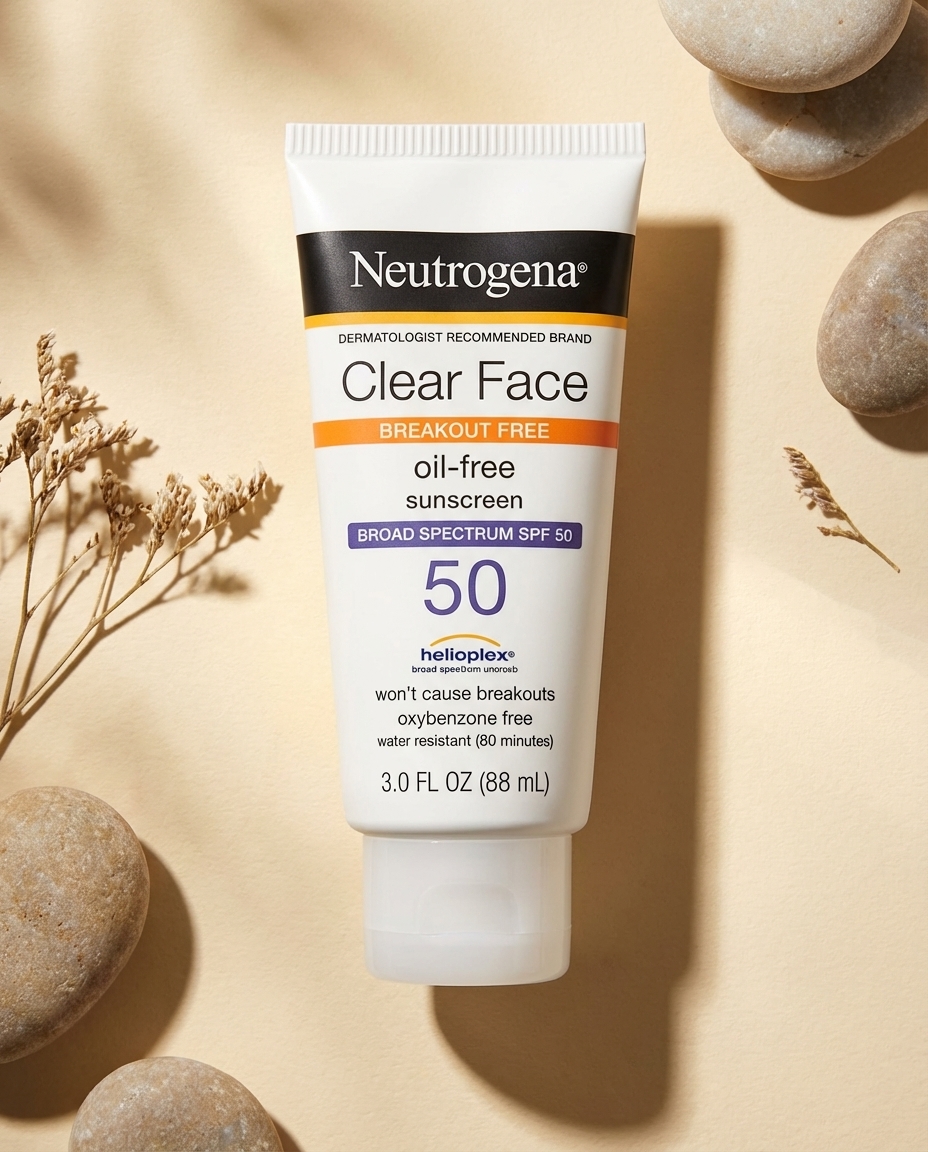
Neutrogena Clear Face Sunscreen Lotion for Acne-Prone Skin
by Neutrogena
What We Like
- Top-rated in its category
- Well-reviewed by skincare enthusiasts
Could Be Better
- Check Amazon for current availability
Frequently Asked Questions
What SPF should men use on their face daily?
SPF 30 is the recommended minimum for daily use. It blocks approximately 97% of UVB rays. SPF 50 offers marginally more protection but the bigger factor is applying it consistently and in sufficient quantity.
Does sunscreen cause breakouts?
Low-quality or poorly formulated sunscreens can. Look for 'non-comedogenic' on the label, and choose lightweight gel or fluid formulas for oily or acne-prone skin. Many men find mineral sunscreens (zinc oxide) less likely to cause congestion.
Is sunscreen necessary if I work indoors?
Yes. UVA rays, which cause skin aging and contribute to skin cancer risk, penetrate windows and glass. Sitting near a window for 8 hours counts as meaningful UV exposure. Daily application is a year-round habit.
Can I just use a moisturizer with SPF?
It helps, but most moisturizers with SPF are not applied in sufficient quantity to deliver the stated protection. A dedicated sunscreen used after moisturizer is the more reliable approach.
Do darker skin tones need sunscreen?
Yes. While melanin provides some natural protection, it is not sufficient to prevent UV damage, skin aging, or skin cancer risk at any skin tone. The degree of protection varies, but the need for sunscreen does not.